Anthropology of Tourism: What for? And for Whom? Criticism of the Tourist Reason
DOI:
https://doi.org/10.3989/dra.2020.001bKeywords:
Anthropology of Tourism, Ethnography, Ethnomarketing of TourismAbstract
Based on the diversity of anthropological approaches (normative, subjective, mixed ...) of tourism, we analyze the role of the ethnography as a methodological and technical tool of tourism anthropology, and also as an epistemological way of thinking, interpreting and take part in tourism In our text we will present the ways to use the ethnography and some of its (in) utilities in our societies in movement. Societies in which tourism has become an indispensable part of the social and cultural identities of many people in the global world. In this sense, researching tourism is to study people, people, cultures, places and mobility, for which ethnography of tourism is specially prepared and called not only to interpret and understand their problems, as well as to intervene and better manage tourism, through ethnomarketing strategies and anthropological planning of tourism.
Downloads
References
Andrews, Hazel, Takmitsu Jimura y Laura Dixon (eds.). 2019. Tourism Ethnographies. Ethics, Methods, Application and Reflexivity. Londres: Routledge. https://doi.org/10.4324/9781315162164
Aramberri, Julio. 2011. Turismo de masas y modernidad. Un enfoque sociológico. Madrid: CIS.
Ateljevic, Irena, Annette Pritchard y Nigel Morgan (eds.). 2007. The Critical Turn in Tourism Studies. Innovative Research Methodologies. Amsterdam: Elsevier. https://doi.org/10.4324/9780080470986
Badot, Olivier, Christophe Carrier, Bernard Cova, Dominique Desjeux y Marc Filser. 2009. «The Contribution of Ethnology to Research in Consumer and Shopper Behavior: Toward Ethnomarketing». Recherche et Applications en Marketing (English Edition) 24(1): 93-112. https://doi.org/10.1177/205157070902400106
Boissevain, Jeremy. 1986. Tourism as Anti-structure. Amsterdam: Euromed Working Paper nº 43.
Chambers, Erve. 2005. «Can the Anthropology of Tourism Make us Better Travelers?» National Association for the Practice of Anthropology Bulletin 23(1): 27-44. https://doi.org/10.1525/napa.2005.23.1.27
Galani-Moutafi, Vasiliki. 1999. «The Self and the Other. Traveler, Ethnographer, Tourist». Annals of Tourism Research 27(1): 203-224. https://doi.org/10.1016/S0160-7383(99)00066-3
Hernández, Javier, Xerardo Pereiro y Roque Pinto. 2015. «Panorama de la Antropología del Turismo desde el Sur». Pasos. Revista de Turismo e Património Cultural 13(2): 277-281. https://doi.org/10.25145/j.pasos.2015.13.020
Latour, Bruno y Stephen Woolgar. 1997. Vida de laboratório. A construção científica dos factos científicos. Río de Janeiro: Relume - Dumará.
Marín Guardado, Gustavo. 2015. «Turismo: espacios y culturas en transformación». Desacatos 47: 6-15.
Nash, Dennison. 1996. Anthropology of Tourism. Oxford: Pergamon.
Nogués Pedregal, Antonio Miguel. 2009a. «Genealogía de la difícil relación entre antropología social y turismo». Pasos. Revista de Turismo y Patrimonio Cultural 7(1): 43-56. https://doi.org/10.25145/j.pasos.2009.07.004
Nogués Pedregal, Antonio Miguel. 2009b «Ocio y tiempo festivo: del trabajo de sol a sol a la imperiosa necesidad de vacaciones», en Salvador Rodríguez Becerra y Clara Macías Sánchez (coords.), El fin del campesinado. Transformaciones culturales de la sociedad rural andaluz en la segunda mitad del siglo XX: 195-218. Sevilla: Junta de Andalucía.
Ordine, Nuccio. 2015. A utilidade do inútil. Pontevedra: Kalandraka.
Pereiro, Xerardo y Martín Gómez-Ullate. 2019. «Pilgrimage Tourism and Cultural Route Team Ethnographies in the Iberian Peninsula: A Collaborative Study», en Hazel Andrews, Laura Dixon y Takamitsu Jimura (eds.), Tourism Ethnographies. Ethics, Methods, Application and Reflexivity: 112-127. Londres: Routledge. https://doi.org/10.4324/9781315162164-8
Pereiro, Xerardo y Filipa Fernandes. 2015. «Antropologia e turismo: dos trilhos, atores e espaços à genealogia da turistificação da Antropologia em Portugal». Pasos. Revista de Turismo e Patrimonio Cultural 13(2): 333-346. https://doi.org/10.25145/j.pasos.2015.13.024
Pereiro, Xerardo y Filipa Fernandes. 2018. Antropologia e turismo. Teorias, métodos, praxis. La Laguna (Tenerife): Pasos Edita, 20. Disponible en: < http://www.pasosonline.org/en/collections/pasos-edits/151-numero-20-antropologia-e-turismo >. Fecha de acceso: 20 ene. 2020.
Pereiro, Xerardo y Paulo Mendes (coords.). 2005. Textos de Antropologia Aplicada. Miranda do Douro: Universidade de Trás-os-Montes e Alto Douro (UTAD).
Phillmore, Jenny y Lisa Goodson (eds.). 2004. Qualitative Research in Tourism. Ontologies, Epistemologies and Methodologies. Londres: Routledge.
Pina Cabral, João de. 2007. «El canon y la condición humana: Retos de la Antropología actual», en Carmelo Lisón Tolosana (ed.), Introducción a la antropología social y cultural. Teoría, método y práctica: 569-589. Madrid: Akal.
Santana, Agustín. 1997. Antropología y turismo. ¿Nuevas hordas, viejas culturas? Barcelona: Ariel.
Selwyn, Tom. 2001. «Bosnia-Hercegovina, Tourists, Anthropologists». Anthropology Today 17(5): 1-2. https://doi.org/10.1111/1467-8322.00075
Simonicca, Alessandro. 1997. Antropologia del turismo. Strategie di ricercca e contesti etnografici. Roma: La Nueva Italia Scientifica.
Slaughter, Sheila y Larry L. Leslie. 1997. Academic Capitalism: Politics, Policies and the Entrepreneurial University. Baltimore: Johns Hopkins.
Steil, Carlos Alberto. 2006. «Antropologia do turismo. Comunidade e desterritorialização», en Elsa Peralta y Marta Anico (orgs.), Património e Identidades. Ficções Contemporâneas: 163-170. Oeiras: Celta Editora.
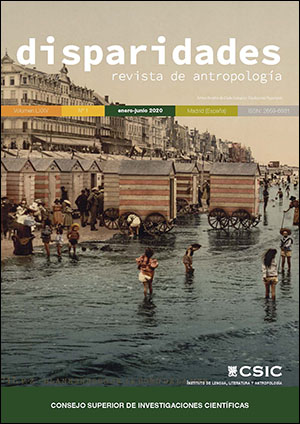
Published
How to Cite
Issue
Section
License
Copyright (c) 2020 Consejo Superior de Investigaciones Científicas (CSIC)

This work is licensed under a Creative Commons Attribution 4.0 International License.
© CSIC. Manuscripts published in both the print and online versions of this journal are the property of the Consejo Superior de Investigaciones Científicas, and quoting this source is a requirement for any partial or full reproduction.
All contents of this electronic edition, except where otherwise noted, are distributed under a Creative Commons Attribution 4.0 International (CC BY 4.0) licence. You may read the basic information and the legal text of the licence. The indication of the CC BY 4.0 licence must be expressly stated in this way when necessary.
Self-archiving in repositories, personal webpages or similar, of any version other than the final version of the work produced by the publisher, is not allowed.